



By dr. Cheryl White
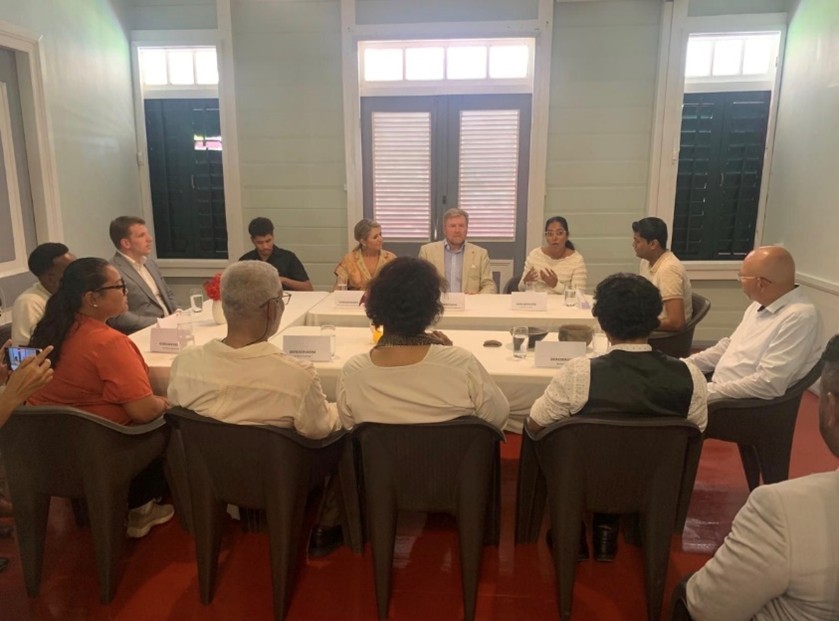
In the accompanying image are a group of Suriname’s young heritage professionals meeting with King Willem-Alexander and Queen Máxima of the Netherland on December 3, 2025 at Plantation Fredericksdorp in the Commewijne River region of Suriname; the likes of which Suriname has not seen since the visit of Prince Bernard and Princess Juliana in the mid-20th century. The presence of Dutch royals at this time loosely represents a new horizon of Dutch/ Suriname relations that has been building for several years.
The meeting was attended by the President of the Republic of Suriname, Dr. Geerlings-Simons, several Government of Suriname ministers, and most notable is the new Minister of Education, Science and Culture, Dirk Currie. The young heritage professionals in the picture, just a small representation of heritage experts in Suriname, are all graduates of the Anton de Kom University of Suriname (AdeKUS), Faculty of Humanities, Department of History’s Bachelors program and specialize in different aspects of heritage: Sushmeeta Ganesh, archaeology and heritage; Jõvan Samson, archaeology and heritage; Georgetine Nremoredjo, archivist and researcher; Amos Constant, researcher and heritage professional; Akaash Jhinkoe, archivist and Chief of Education; and Agir Axwijk, historian. Each pursued a Master’s degree in the Netherlands (via the Cultural Heritage Scholarship Program) and at the AdeKUS. More important to this discussion is that they have each chosen to give their expertise, knowledge and a critical decolonial eye to Suriname’s material and immaterial heritage sector moving forward, like so many others have done before them. But is the heritage sector, governmental, private and non-governmental, ready for them?
The Netherlands is engaged in a reckoning of its colonial past, and in so doing is attempting to lead with a vision to understand how it may support and simultaneously not hinder the pursuits of professionals in the former colonies. But have Surinamese heritage institutes followed suit? What critical questions about a Surinamese heritage workforce are being asked? How are laws and policies being designed and implemented to ensure heritage professionals, of all proficiencies and capacities, are given the support and space to thrive?
“By design, not by default”
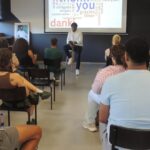
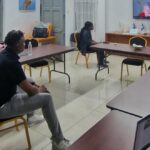
On the 23 December, 2025 Minister Currie held a follow-up meeting with the young professionals to discuss their role in the further development of Suriname’s heritage sector. They discussed challenges to the growth of the sector and how their inclusion is often hindered due to the lack of government accountability, laws, policies, communication and facilities. At this time, Min. Currie stated that the bedrock of his approach, is leadership, and more importantly that the integration of Surinamese professionals should be “by design, not by default”. This slogan suggests that the integration of Surinamese professionals ought to be with intentionality for critical intellectual contribution, decision making, implementation, stewardship, and public awareness, in all facets of heritage.



Many of the young professionals that met with Min. Currie have established themselves with noteworthy strides. Sushmeeta Ganesh and Jovan Samson conducted relevant archaeological research at Jodensavanne, thereby contributing to its 2023 induction to the UNESCO World Heritage Site list. Furthermore, they have been consistently involved in archaeological surveys for the large-scale mining sector for several years. In addition, there is outreach via the Kinderuniversiteit of Suriname and the annual UNESCO archaeology volunteer program. Moreover, the National Archives of Suriname (NAS) employs several of the young professionals that were present at both meetings. NAS has been an inroad and an outlet for the professional development of Surinamers to pursue sustained research in material and immaterial heritage.
These efforts are a reflection of their training, broadly speaking, in public history, heritage policy, education and dissemination, heritage management within both public and private institutions, academic training and professional skills development. And more importantly, they have learned that heritage concepts, policies and practices need to be critically examined.
In another vein, the Monument Law of 2002 (though riddled with flaws), the Directorate of Culture’s Archaeological Services ought to refer likely professionals for the research of newly reported archaeological sites. It states that, The Minister may, after consulting the Commission, appoint services, institutions or persons who are authorized to carry out or have carried out excavation work as referred to in Article 17 paragraph 1, in accordance with the rules to be laid down by him. This law facilitates participation of Surinamese professionals in the private sector and thereby creates a niche for experienced and newly minted advanced degree graduates to earn a living and apply additional mixed methods, i.e., archival analysis, material culture study, and or tourism implications. Moreover, there are numerous other organizations in Suriname that have contributed to the documentation and sharing of material and immaterial heritage that would also benefit from its application, such as NAKS [Na Afrikan Kulturu fu Sranan], the Suriname Museum, Kibri Foundation, UNESCO, Bakki, Saamaka Museum, to name but a few.
According to Rosita Leeflang, chairman of the Stichting K.A.S.E.K.O. (Kerngroep Accreditatie Surinaams Erfgoed door Kaseko Onderzoek), there needs to be more efficient communication about ICH [intangible cultural heritage] measures from government to nongovernmental organizations and civil society. At a December 13 panel discussion during the National Day of Kaseko it was suggested that Suriname create its own version of KIEN [Kenniscentraal Immaterial Erfgoed Nederlands] for idea exchange and cross talk about international regulations and national efforts for data acquisition and policy development as it relates to the Nationale Register voor Immaterieel Cultureel Erfgoed (Personal Communication January 13, 2026). This act would build inclusivity, representation and knowledge sharing.

What is the agenda?
In a broader context, the Bouwen in Vertrouwen… report (September 2025), an IOB Evaluation of the Makandra Program from 2021-2025 states that, “In het Internationaal Cultuur Beleidskader 2025-2028 van de Nederlandse overheid is Suriname een van de 24 prioriteits landen” (15). The support is intended for social initiatives and policy intensification, particularly since heritage was identified as one of the common priorities of both the Government of Suriname’s Ministry of Education, Science and Culture and the Dutch counterpart (46). In its evaluation the report observes what is needed is “a more active involvement of knowledge institutions, civil society organizations, and the business community in initiatives aimed at capacity building of government organizations. To this end, also improving communication to these target groups in Suriname about the structure, objectives, available resources, and relevant procedures” (9). In addition, the report notes a lack of a critical mass in human resources due to a brain drain of formally educated persons leaving Suriname for better opportunities elsewhere. If not addressed, these observations may become a hindrance to any significant growth in Suriname’s heritage sector.
A relevant highlight of the Makandra Program was the training of policy officers from the Ministry of Education, Science, and Culture in Suriname (OWC) to draft a heritage law in consultation with civil society organizations (IOB 2025: 42). According to the former Director of Culture, Dweight Warsodikromo, the first phase of this effort is complete; an inventory of the national laws that overlap with international conventions. The next step is to write the law with the consultation of a legal professional. But at the time of Warsodikromo’s tenure, the Directorate of Culture did not have the available funds to carry this out (Personal Communication January 13, 2026). It has yet to be determined or communicated when and how the spectrum of heritage professionals and their concerns, will be integrated into this process.
When it is time for the construction of a heritage law and subsequent policies, we should be mindful of whether or not the process considers how heritage professionals are incorporated “by design and not by default”. We should not be so naïve as to avoid the matter of coloniality. The Kennisagenda 2025-2035: ‘Het Nederlandse koloniale slavernijverleden en zijn doorwerkingen produced by Rose Marie Allen et al. articulates a guide for multi-year research. The core aim is “…to guide knowledge development for scientific research, and contribute to other forms of knowledge production and knowledge transfer, for example, in the heritage sector, education, and training” (9). It considers several theoretical positions and themes to be explored via mix-method approach. But more importantly it asks to consider “the broader involvement of institutions and society” (30). In so doing we may understand historic exclusionary practices and how to ensure they are not perpetuated into the future. The tenets of the Kennisagenda… are echoed in AdeKUS’ research prospectus, Kennis-en Onderzoekagenda Slavernij Doorwerking in Meersteemig Perspectief (2025) by Drs. Helmut Gezius, Dr. Eric Jagdew and Prof. dr. Sanches with the goal to centralize a “Surinamese Perspective” in social science research. “To address the legacy of slavery, it is necessary to recognize the ways in which this history has shaped and continues to shape Afro-Surinamese and Indigenous societies in particular” (3). These initiatives represent but a fraction of what a heritage agenda ought to reflect, but it provides a point of departure to consider how research may be better structured and institutionalized for the participation of a deeper pool of heritage professionals.
There are many perspectives to be considered here. In order to integrate the “by design and not by default” concept we need to ask these questions with the expectation of receiving an answer. How will laws and policies be of service to working and aspiring heritage professionals? How will the production of knowledge be democratized to support the perspective of Surinamers? How will the professional development of Surinamese heritage specialist be facilitated moving forward?
The intentionality of the heritage sector deserves greater attention and critical analysis. We should not rest on the symbolism of the meeting between the Dutch royals and heads of government with the young heritage professionals. It should instead be a spring board for Surinamese heritage specialist to further the heritage sector in the short, medium and long term. These issues are the common business of Suriname. And need to be refined if Surinamese heritage professionals are to see themselves in the sector moving forward and more importantly, own the space to create the historical narrative of their country.
A lesser goal will not succeed.
Cheryl White isan associate professor at the Anton de Kom University of Suriname (AdeKUS), Faculty of Humanities (FdHum) since 2014