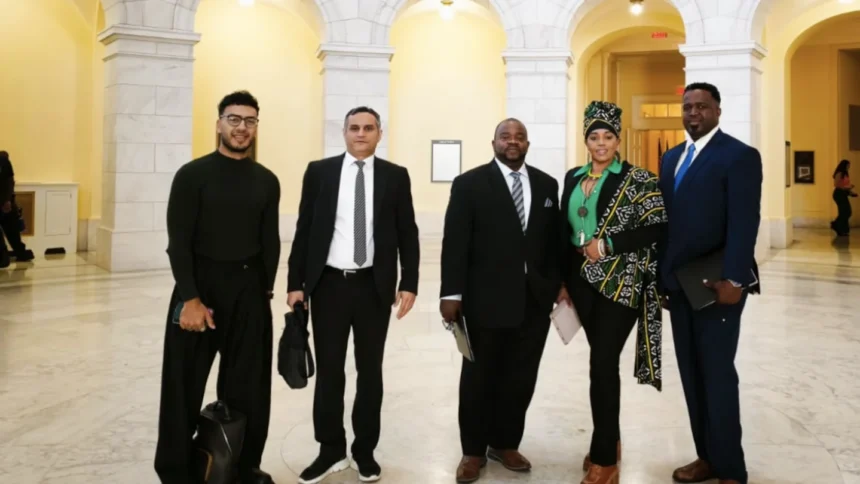
“A people who do not know their story are easily told who they are by others.” With that message, Charles Albertis Woodley, former Commissioner and All for 1 Union leader, addressed the international conference “Right of Return and Self-Determination: Double Standards and Selective Approaches” in Washington D.C. on June 24.
Speaking in the Kennedy Caucus Room of the Russell Senate Office Building, organized by the Baku Initiative Group, he delivered a powerful speech on the hidden history of Sint Eustatius and its consequences for identity and self-governance.
Woodley described how, as a child, he did not fully grasp what it meant to live under colonial rule, until a simple question from his childhood friend, now Prime Minister of St. Kitts and Nevis Terrance Drew, stayed with him: “How did they become yours?” It was only years later, during an Emancipation Day celebration in 2016, that he learned a revolt had taken place on Statia in 1848, an event never taught in school. Free and enslaved Africans had demanded liberty, increased rations, and more free hours. The uprising was violently suppressed, and its leaders, among them Thomas Dupersoy, were exiled to Curaçao.
That discovery led Woodley back to his own family’s story. “As a child, I often heard my father say, ‘I am from the Congo race.’ Many dismissed those statements, yet my father knew where he came from,” Woodley recalled. It was his way of preserving a connection to his roots, at a time when that knowledge was rarely passed down. He later understood why: the people from the north of the island, known as the Congo people, were recognized for their unyielding dignity, refusing to address plantation owners as “master.”
Woodley connected this history to his own experience as Commissioner during the Dutch government’s dissolution of the island’s elected government in 2018, an event he describes as a stark example of the power imbalance between small Caribbean territories and their metropolitan states. Referring to UN principles on self-determination and decolonization, including Resolutions 1514 and 1541, he argued that Statia’s case is not an isolated one, but part of a broader international conversation.

His message to the island’s youth is clear: their history belongs in the school curriculum. Those who know their story stand firmly in their identity.
The full speech by Charles Woodley can be read here.