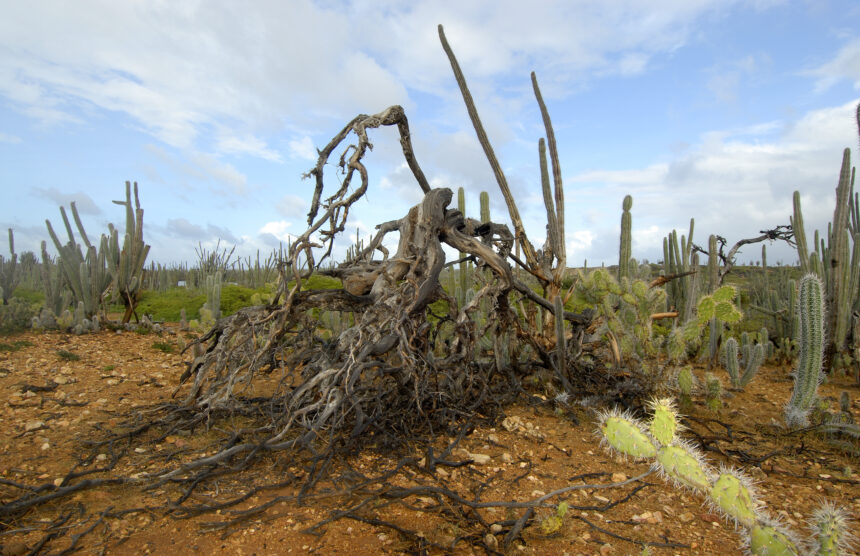
Bonaire’s tropical dry forests are full of life. They are home to native trees, cacti and palms, as well as birds, reptiles, insects and many other species. Some of these plants and animals are rare or found only on our islands, making these forests a unique part of Bonaire’s natural and cultural landscape.
And they do more than give wildlife a place to live. They help protect the island we all depend on.
Trees, shrubs, herbs and grasses hold soil in place, especially when heavy rain falls. Without vegetation, loose soil can wash downhill and eventually end up in the sea. Vegetation also helps keep the ground cooler. We all know how good it feels to stand under a large tree on a hot day. A healthy canopy can also help the soil hold on to moisture for longer.
In other words, more vegetation means more shade, more moisture and more protection for the land and the life that depends on it.
What happens when there is less pressure from grazers?
A 15-year study on Bonaire provides answers.
Researchers from Wageningen University & Research, STINAPA Bonaire, Echo Foundation and BonBèrdè followed restoration efforts in different parts of the island. They looked at fenced areas where grazers were excluded, grazer management in Washington Slagbaai National Park, and areas where thousands of native trees were planted.
The results are clear: when goats and other grazers are excluded, natural regeneration increases substantially. More young tree seedlings start to appear, especially after wetter years.
That’s important because it tells us something encouraging. In some places, the forest may already have much of what it needs to start growing back. The seeds are there. Young plants are there. The main thing missing is enough time for them to develop.


Forest recovery takes time
But that does not mean a forest comes back overnight. On Bonaire, it took as long as 15 years before researchers saw a clear increase in larger young trees and adult trees. And even then, only around one third of Bonaire’s dry-forest tree species were returning naturally.
This is where restoration can make a difference. Many native trees planted inside protected areas survived well, showing that combining natural recovery with targeted planting can help bring back a wider range of native trees.


Proyekto Parke Bunita in Washington Slagbaai National Park is a visible example. Where goats have been removed, vegetation is recovering and young native trees get a chance to grow.
Lessons from other islands
Bonaire is not the only island where removing or excluding free-roaming grazers has helped native vegetation recover. In parts of Curaçao’s Christoffelpark, goats were removed or kept out, and the native Sabal palm gradually returned. The number of adult palms increased from 323 in 1979 to more than 1,000 in 2018. Young palms also became much more common.
Saba offers a more recent example. Since 2020, more than 90% of its free-roaming livestock has been removed. Grasses and shrubs are returning across hillsides, while young trees are beginning to survive in places where overgrazing previously kept them from growing.
And this approach is not unique to the Dutch Caribbean. Around the world, conservation teams on islands have used the removal or exclusion of introduced grazers to give native vegetation a chance to recover. On Redonda in Antigua & Barbuda and on several Galápagos Islands, for example, controlling or removing goats and other invasive animals was followed by the recovery of native vegetation and wildlife.

Finding the right balance
Grazing animals have been part of island life for generations. Goat farming in particular has an important historical, cultural and economic place on our islands. So the issue is not that goats exist. The challenge comes when too many grazing animals have unrestricted access to natural areas for too long. A young tree can be eaten before it ever gets the chance to become a tree. When this happens year after year, forests gradually lose their ability to renew themselves.
And grazing is not the only pressure. Dry forests also face development, land clearing, invasive species, drought and climate change. The Key Habitats Program identifi es free-roaming grazers as one of the pressures affecting tropical dry forest and scrub, alongside several others.
The goal is therefore not an island without grazers. It is fi nding ways to manage grazing so livestock can remain part of island life, while natural areas have enough space to recover.
How you can help
A forest does not come back in a few years. It takes time, patience and people who are willing to stick with it. On Bonaire, people and families with deep roots on the island, together with residents, volunteers, students, schoolchildren and conservation organizations, are already contributing through planting, monitoring and restoration activities.
There are many ways to be part of that effort. Protect native vegetation. Respect fenced recovery areas. Join restoration activities. And support the organizations working to restore Bonaire’s landscapes. Every young tree that gets the chance to grow is a small step towards a healthier forest.
DCNA’s Key Habitats Program
Reducing the impact of free-roaming grazers is one part of DCNA’s Conservation and Restoration of Key Habitats Program, a regional program focused on protecting and restoring fi ve key habitats across the Dutch Caribbean.
By bringing together science, local knowledge, expertise and action, the program looks beyond restoring habitats alone. It works towards a Dutch Caribbean where nature is safeguarded, ecosystems are restored and communities can live in harmony with nature.
More information can be found at dcnanature.org/keyhabitatsprogram.