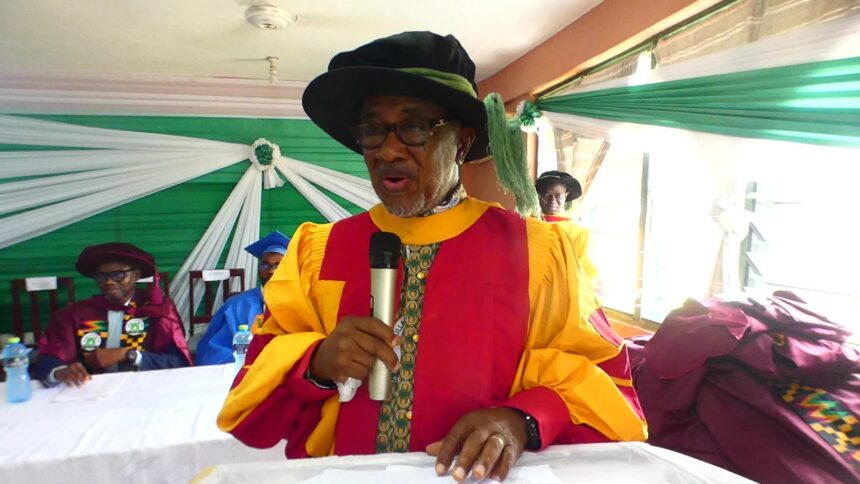
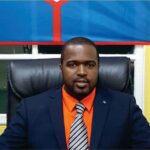
Ghanaian scholar Professor Dr. David Millar, founder and president of the Millar Institute for Transdisciplinary and Development Studies, arrives in the Netherlands on Monday 16 November. He has travelled from Bolgatanga in northern Ghana to Accra, and from there he flies on to teach in the Afrocentric programme he runs together with the Broos Institute for Afrocentric Studies and Research. During his visit he will also give a public guest lecture at Wageningen University & Research. His message: decolonisation is about more than reparations. It is about knowledge.
“For us as an institute, it is a pride and a recognition to run a programme in the Netherlands with the Broos Institute. Most Western universities come to give their courses in African universities. The same motivation they have for coming to Africa is the motivation we have to teach here, thanks to our partnership with the Broos Institute.”
Professor David Millar
Millar’s visit is the latest step in a partnership that goes back several years. In May 2024, a Broos Institute delegation visited the Millar Institute in Bolgatanga, in Ghana’s Upper East Region. Two months later, the two institutions signed a memorandum of understanding for joint academic activities. Since then, the Broos Institute has represented the Millar Institute in Europe, and the partners have been working towards a shared ambition: the first Afrocentric university campus in the Netherlands, with hybrid and online bachelor’s, master’s and PhD programmes, certificates and short courses.
That ambition is older still. As early as 2022, the Broos Institute – named after Broos, a nineteenth-century Surinamese Maroon leader and resistance fighter – announced its plan for an inclusive university in the Netherlands offering education from an Afrocentric perspective. The partnership with Millar has given that plan an accredited academic home.
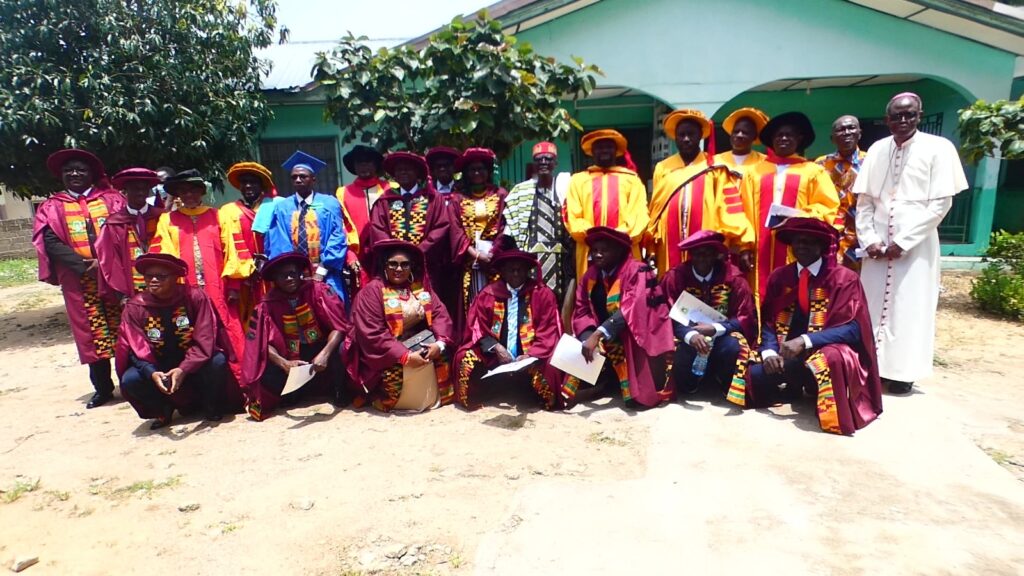
Millar founded his institute in September 2014 as the first fully privately funded institution of higher education in northern Ghana. Since then it has produced dozens of master’s and PhD graduates, and its MPhil and PhD programmes in Culture and Development Studies are accredited by Ghana’s Tertiary Education Commission.

Decolonisation and Afrocentric Knowledge
The programme that brings Millar to the Netherlands is Decolonisation and Afrocentric Knowledge, a university-level course offered by the Millar Institute and the Broos Institute. It is the first time an African university has offered an Afrocentric programme at this level in the Netherlands. Classes take place in Amsterdam Southeast, at MBO College ROC van Amsterdam.
The first block, Foundations of Afrocentric Knowledge, was taught in September and October by Ghanaian professor Mamudu Abunga Akudugu.
The second block was taught by Dr. Francis Niagia Santuah and Larry Olomoofe. Professor Millar teaches the third block, with co-lecturer Bertus Haverkort.
For Millar, it matters that the teaching is shared with European colleagues. “We are not only teaching as African scholars; we are working with European colleagues who share the same mindset. That adds weight to our case for a collegial atmosphere.” The Broos Institute, he says, is the starting point for that outreach to Europe.
He does not come empty-handed. Millar is bringing a set of core books for his students. “Normally I give a list of core books, but I also let students do their own search,” he says. The books will be available in class so that every student can borrow one.

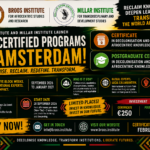
The theme of his Wageningen lecture, Decolonization Through Education: The Role of the Young Practitioner, runs through all of his work: the role of education in decolonising knowledge systems.
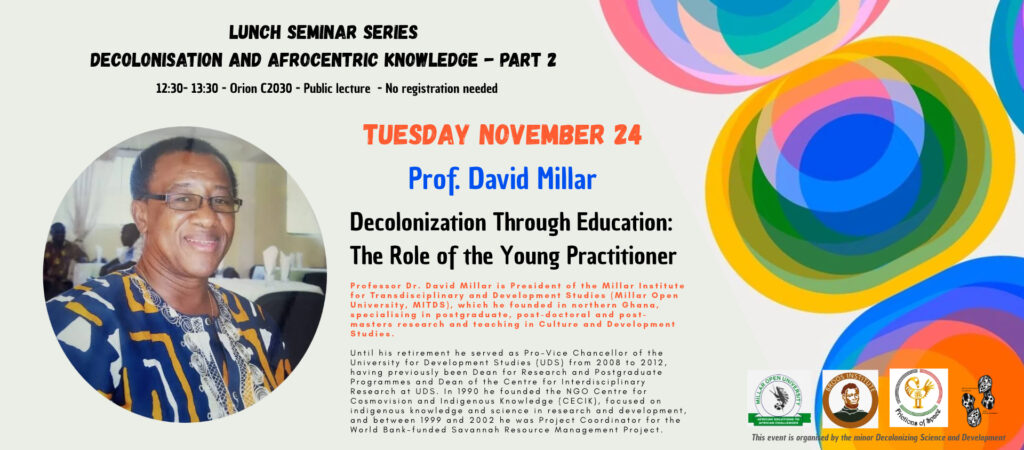
“We believe our knowledge systems have been undermined and underexplored,” Millar says. “And that continues in what they call the new colonisation.” By undermining he means that Western concepts, Western curricula, Western ways of spreading knowledge and even Western technology are still the norm. “In all those areas, nothing is done with African knowledge systems.”
He is critical of how the decolonisation debate itself is often conducted. “The pioneers of decolonisation talk about reparations, governance, slavery and the compensation that should be paid. But very little is said about bringing the knowledge to the fore.” Indian, Latin American and Chinese knowledge systems have earned their place in science. Only the African knowledge system is given little or no room to reach that level.
At the Millar Institute, that conviction is built into the curriculum. The open university, which Millar founded in Bolgatanga in 2014, has now produced some 60 PhD graduates, with around 100 more doctoral candidates enrolled. Every thesis must contain a full chapter on what the research means for indigenous knowledge systems; some theses are devoted entirely to reconstructing that knowledge.
“We use the same concepts, the same standards, the same measures. Otherwise it wouldn’t be a PhD.” The result is a synergy between indigenous and Western systems. According to Millar, students understand the dynamics and power relations much better than when they study only one system.
“They become more complete. And if we all incorporated African knowledge systems in our work, it would make all of us more holistic people.”
This is not about replacing anything, he stresses. “We argue for integration and a collegial relationship. The Western approach was to subjugate, to suppress.” His goal: a PhD graduate rooted in African knowledge who engages a Western scholar in debate as an equal.
The institute does this with little support. While donors and governments invest heavily in ICT and artificial intelligence, Millar says there is no comparable funding to use that same technology to record, develop and share indigenous knowledge. “There is lip service that African and indigenous knowledge systems are important, but we don’t get the support needed to bring them to the fore.”
Millar’s visit builds on a collaboration that goes back several years. As early as 2022, the Broos Institute – named after the nineteenth-century Surinamese Maroon leader Broos – announced its plan for an inclusive university in the Netherlands with an Afrocentric perspective. In May 2024 a Broos delegation visited Bolgatanga, and that summer the two institutes signed a memorandum of understanding. Since then the Broos Institute has represented the Millar Institute in Europe, and in 2024 it ran a crowdfunding campaign for its partner’s tenth anniversary.
Guest lecture
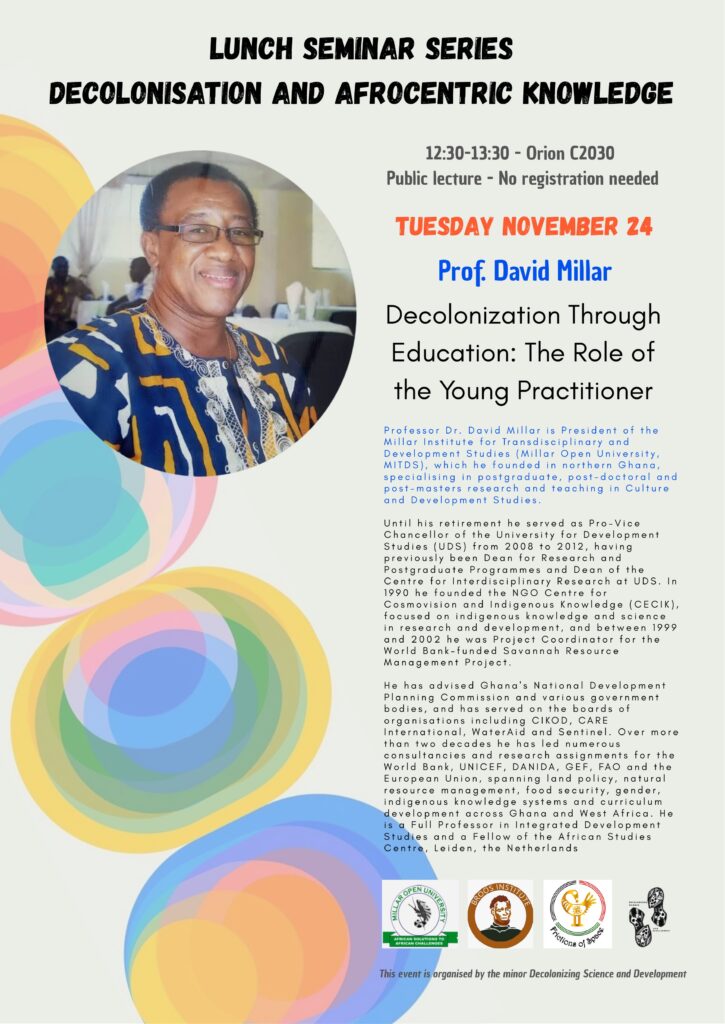
Decolonization Through Education: The Role of the Young Practitioner – Prof. David Millar
- When: Tuesday 24 November, 12:30–13:30
- Where: Orion, room C2030, Wageningen University & Research
- Admission: public lecture, no registration needed
- Organised by the minor Decolonizing Science and Development
About David Millar
Millar is a Full Professor in Integrated Development Studies and a Fellow of the African Studies Centre in Leiden. From 2008 to 2012 he was Pro-Vice-Chancellor of the University for Development Studies (UDS) in Ghana. In 2014 he founded the Millar Institute for Transdisciplinary and Development Studies.
About the Broos Institute for Afrocentric Studies and Research
The Broos Institute is an Amsterdam-based non-profit organisation that brings Afrocentric perspectives into education. It is named after Broos, a nineteenth-century Maroon leader and resistance fighter from Suriname. Together with Anton de Kom University of Suriname (AdeKUS) and Kwame Nkrumah University of Science and Technology (KNUST) in Ghana, the institute ran the Africana Development Studies Program, making it the first educational foundation in the Netherlands to launch an African studies programme at university level. Since 2024 the Broos Institute has represented the Millar Institute in Europe, making it the first African university campus in the Netherlands.
Alongside education, the Broos Institute carries out academic research. In 2025 it led groundbreaking archaeological fieldwork at Plantation Toledo in Suriname, in partnership with Anton de Kom University – the first time Surinamese students carried out targeted research into the lives of enslaved Africans on a former plantation. The institute also conducted a study of the relationships between Afro-Surinamese and Caribbean civil society organisations and educational institutions in the Netherlands.