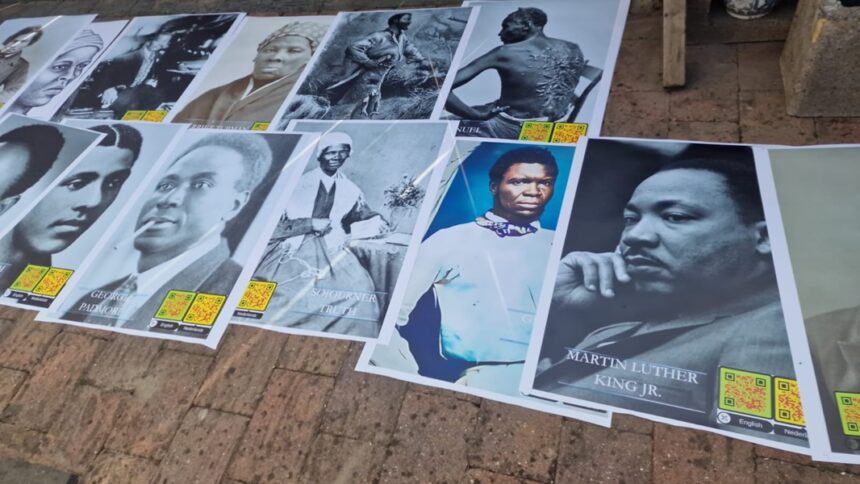
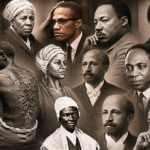
At the Assin Manso Ancestral Slave River Park in Ghana, 14 renewed portraits of Black freedom fighters and thinkers will be officially launched on 1 August, during the annual Emancipation Day commemoration. The portraits, a donation from AFRO Magazine, carry QR codes that give visitors direct access to the stories behind the heroes depicted.
The park’s open-air museum displays portraits of, among others, Harriet Tubman, Frederick Douglass, Queen Nanny of the Maroons, Nat Turner, Kwame Nkrumah, Marcus Garvey, Malcolm X, Martin Luther King Jr., Sojourner Truth and W.E.B. Du Bois. The Surinamese freedom fighter Broos Babel, leader of the Brooskampers, is also part of the series.
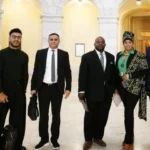
During a visit to the park in May, AFRO Magazine founder Marvin Hokstam Baapoure noticed that the existing portraits had faded and were torn in places. He offered on the spot to renew the entire series. In June, the new portraits were sent to Ghana with a traveller. Bigi Bon, AFRO Magazine’s parent foundation, found the funds to make it all possible.
Every photograph in the series now carries a QR code leading to a page on AFRO Magazine with background information on the fourteen heroes and on the historical significance of Assin Manso.
The Dutch-language QR code leads to the same article on AFROMagazine.nl, in Dutch.
“We must also bring”


Hokstam Baapoure explicitly places the donation in a wider context. “Our relationship with Africa — that of the West, and also that of Black people in the West — is too extractive. All we do is take. Resources, and these days increasingly heritage as well. We must also — no, we have a moral obligation to also bring.”
Kwame Divine, Resource Manager of the Assin Manso Ancestral Slave River Park, received the portraits. “Receiving these photographs is both an honour and a responsibility,” Divine said.
“They are not merely images for display but symbols of sacrifice, courage, and the enduring struggle for freedom. The donation reflects a shared commitment to preserving our collective memory and ensuring that visitors to Assin Manso encounter a history that is authentic, dignified, and inspiring. I accept this contribution with deep appreciation and a renewed commitment to safeguarding and interpreting these stories for present and future generations.”

Sacred ground
Assin Manso, in Ghana’s Central Region, is regarded as one of the most meaningful sites for the African diaspora. At the Donkor Nsuo river, known as the “Slave River”, enslaved Africans took their last bath on African soil before being marched to the slave forts of Cape Coast and Elmina. The grounds also hold the Ancestral Graveyard, where in 1998 the remains of two enslaved Africans from Jamaica and the United States were ceremonially reinterred.
Since that same year, Ghana has been one of the few African countries to formally observe Emancipation Day on 1 August, commemorating the abolition of slavery. Assin Manso forms the centrepiece of the festivities, with wreath-laying ceremonies, libations, the commemoration of the “Last Bath” and a cultural durbar featuring chiefs, queen mothers and traditional performances. This year, the launch of the renewed portraits is part of the programme.