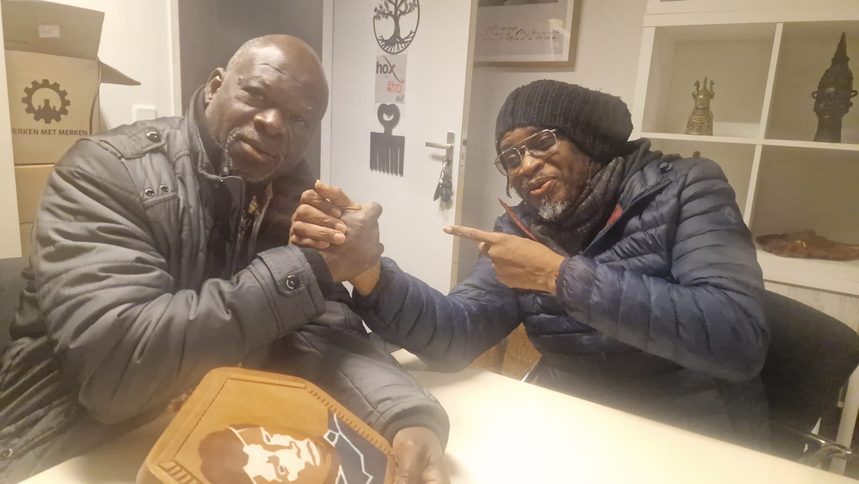
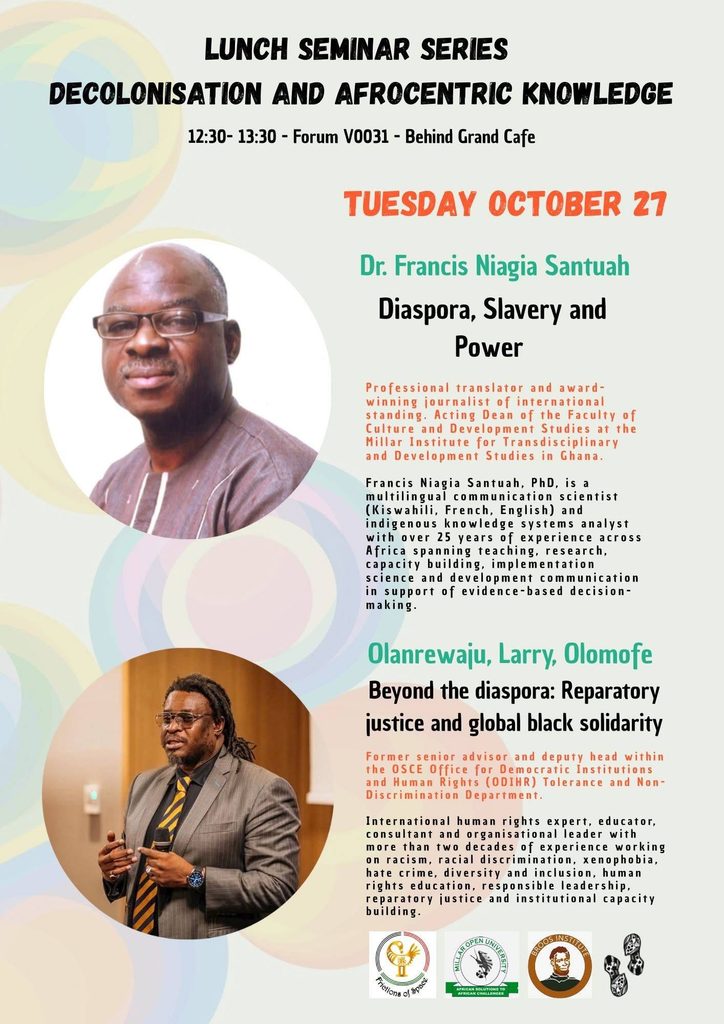
Ghanaian scholar Dr. Francis Niagia Santuah and human rights expert Olanrewaju ‘Larry’ Olomoofe are currently in the Netherlands to teach the second block of the Decolonisation and Afrocentric Knowledge programme at the Broos Institute. On Tuesday 27 October, they will be guests at the lunch seminar series of Wageningen University & Research. In their abstracts, they announce that they will speak about diaspora, slavery, power and reparation.
“I’m looking forward to it,” says Santuah. He uses the Swahili proverb “Mtoto mleavyo hivyo ndivyo akuavyo” (as you raise a child, so it grows) as the subtitle of his contribution in Wageningen. “What a society teaches its children about maps, history, knowledge and seed determines how those children will later see themselves and the world,” he says.
Olomoofe has titled his talk “Beyond the diaspora: Reparatory justice and global black solidarity”. He explores how the African diaspora is structured, where its boundaries lie, and how the struggle for recognition and reparation is developing into a global Black solidarity movement.

For the lecturers, Wageningen is an excursion from Amsterdam Southeast. There, in the building of MBO College ROC van Amsterdam, they teach the second block of the programme that the Broos Institute for African Studies and Research offers together with Ghana’s Millar Institute for Transdisciplinary and Development Studies. It is the first time that an African university has offered an Afrocentric programme at university level in the Netherlands. Around ten students are taking part.
The programme kicked off last September with the block Foundations of Afrocentric Knowledge, taught by Ghanaian professor Mamudu Abunga Akudugu. Akudugu is a professor of agricultural economics. Over eight evening sessions, from 29 September to 8 October, he covered topics including African philosophy and spirituality, the decolonisation of knowledge, and why knowledge is not universal.
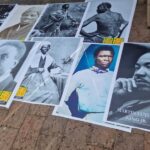
Last week, Santuah taught the first part of the second block. He discussed topics such as Afrocentric leadership and the difference between African consensus decision-making and Western majority democracy. He also spoke about ‘Mercators’, referring to the UN decision to show Africa at its true size on world maps.
“Many Mercators still hang in African classrooms: ideas taught as neutral that are in fact colonial projections. Think of history that only begins ‘when Europeans discovered the Gold Coast’. Mercator stayed on the wall for 457 years, not because Europeans forced us to keep it. It stayed because we did not challenge, did not ask, did not question,” he said.
In the coming days, Olomoofe will address topics from an African diaspora perspective.
About Santuah and Olomoofe
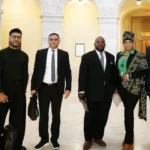
Francis Niagia Santuah is a multilingual communication scientist (Swahili, French, English) and indigenous knowledge systems analyst. He has more than 25 years of experience in education, research and development communication across Africa. He is Acting Dean of the Faculty of Culture and Development Studies at the Millar Institute. He is also an award-winning journalist and professional translator.
Olanrewaju ‘Larry’ Olomoofe is an international human rights expert, educator and consultant. The British-Nigerian was senior advisor and deputy head of the Tolerance and Non-Discrimination Department of the OSCE Office for Democratic Institutions and Human Rights (ODIHR). For more than twenty years he has worked on racism, xenophobia, hate crime, human rights education, responsible leadership and reparatory justice.
About the Broos Institute
The Broos Institute for Afrocentric Studies and Research aims to bring Afrocentric perspectives into the Eurocentric education system. To that end, it works with knowledge institutions in Ghana and Suriname, including the Millar Institute in Bolgatanga, KNUST and Anton de Kom University. In 2025, the institute carried out research on a former plantation in Suriname, examining how enslaved Africans influenced its layout. The Decolonisation and Afrocentric Knowledge programme has been in preparation since 2025. The intention is to make it an annual programme that will grow into a Master’s programme.
“For too long, we have learned about Africa from books written elsewhere. With this programme, we go straight to the source: African scholars. That way, people in the diaspora can learn to see themselves and their history through their own eyes”
Broos Institute for Afrocentric Studies and Research.
The appearance at Wageningen, the world’s leading agricultural university, is the result of a collaboration between the Broos Institute and WUR. The lunch seminar series will continue in November and January with the Ghanaian lecturers who are still to come to the Netherlands for the programme.