
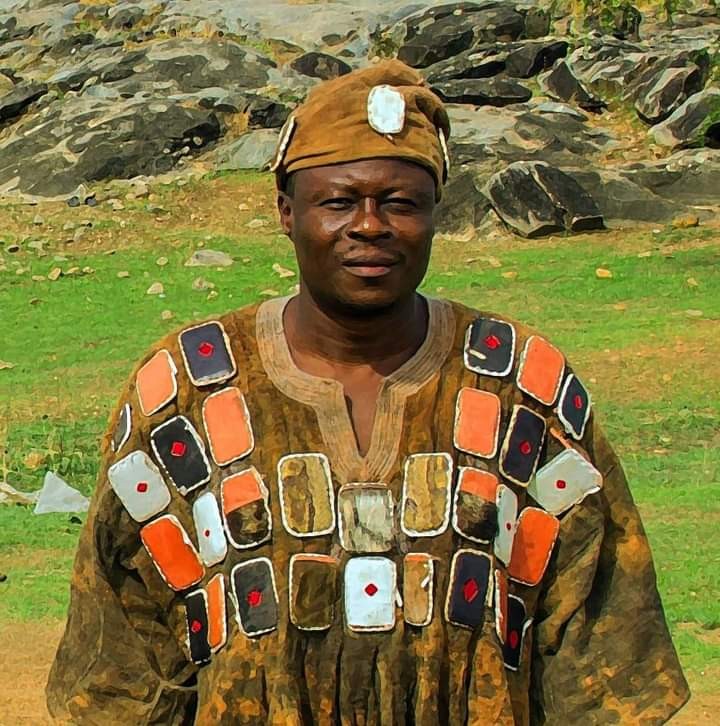
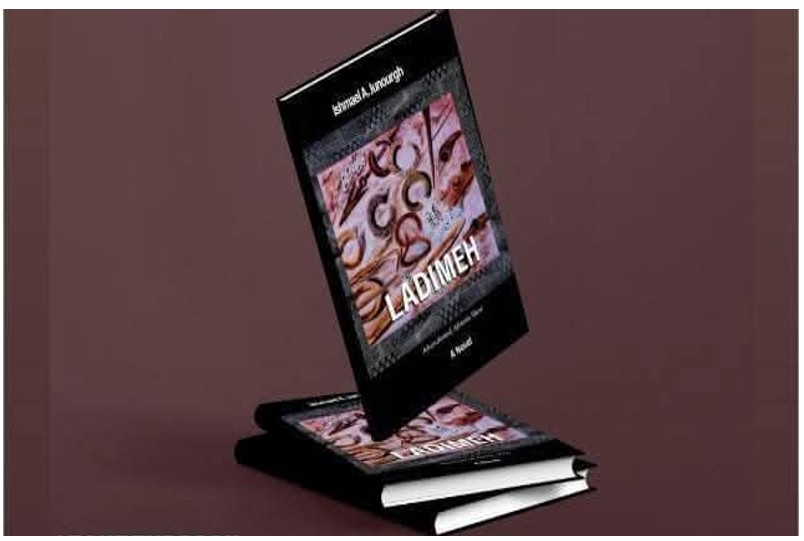
Before the raiders come, there is a village. There are mothers, children, traditions, and a world fully alive. This seemingly simple decision — to show African life in its dignity and fullness before destruction arrives — is perhaps the most powerful political act in Ladimeh: Abandoned African Slave, the latest novel from Ghanaian writer Ishmael A. Junourgh. It is also the one that sets the book apart.
The novel opens with an act of desperate maternal love: an infant, still breastfeeding, hidden beneath his mother’s body as raiders tear through their village of Buulu. The child survives. The world he was born into does not. From that moment of concealment — at once tender and terrifying — the novel unfolds as a long reckoning with what was lost.
Junourgh, a graduate student at the Institute of African Studies at the University of Ghana, Legon, writes writes in the tradition of his ancestors -Kisabla Gyedu Juru Buburwu and Buburwu Diatah- and with the sensibility of a griot, the West African tradition of oral historian and storyteller. He has spoken of his work as a continuation of an ancestral calling, describing his method as using “a needle and thread” of indigenous storytelling to knit his narratives.


“Before my great grandfather passed on, he gave me two things — a needle and a thread — symbolic of the indigenous storytelling techniques.”
In Ladimeh, that technique is everywhere visible: in the careful layering of culture before catastrophe, in the attention to the texture of communal life, and in the deliberate humanisation of a protagonist whom history might otherwise reduce to a statistic.



“The enslaved are stripped not only of freedom, but also of identity, memory, dignity, and belonging.”
What distinguishes Junourgh’s vision of African slavery from many Western literary treatments is its specificity. Ladimeh is not transported across an ocean. He is absorbed — assimilated, the novel calls it — into a family and community that is not his own, within the African continent itself. He labours, he proves himself, he earns trust. And yet social walls remain. He cannot freely choose a wife. He cannot ascend to political leadership. He is human in every moral sense, and subordinate in every structural one.
This is where the novel enters into explicit dialogue with scholarship. Junourgh engages directly with Orlando Patterson’s influential concept of “social death” — the idea that the enslaved person was rendered a non-being, stripped of all social ties and civic existence. Ladimeh complicates that framework. In the pre-industrial African context the novel depicts, Ladimeh is not socially dead. He is recognised, valued, even respected. But he is also permanently marked, permanently other. The novel suggests this is a different kind of violence — more insidious, perhaps, for being so much harder to name.
Junourgh is careful never to reduce Africa to victimhood. The communities in the novel have governance, ceremony, kinship systems, and philosophy. They are not waiting to be defined by what happens to them. This matters enormously in a global literary culture that has too often portrayed the continent as a place without history until contact with the outside world. Ladimeh insists otherwise — quietly, persistently, on every page.

The psychological dimension of the book is equally ambitious. Junourgh is interested not just in what slavery does to the body, but in what it does to the self — to memory, to language, to the ability to recognise one’s own reflection. Ladimeh’s journey is as internal as it is geographic: a sustained inquiry into how identity survives when everything that once anchored it has been stripped away.
Ladimeh: Abandoned African Slave is Junourgh’s third novel, following his internationally recognised debut Not Forsaken: Diaries of an African Child (2019) and its sequel Ancestors Prologue (2022). It is, in many ways, his most demanding and most necessary work yet — a book that asks readers to sit with complexity, to resist simple narratives of oppression and survival, and to hold simultaneously in mind the horror of what was done and the full humanity of those to whom it was done.
In a literary moment saturated with stories of Atlantic slavery and its legacies, Ladimeh offers something rarer: a portrait of a different kind of captivity, rooted in the African interior, told from within, and narrated with the patience of a tradition that has always known that the truest stories take time to tell.